











The Lavin Agency Speakers Bureau
A speakers bureau that represents the best original thinkers,
writers, and doers for speaking engagements.

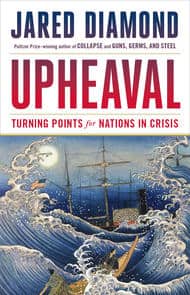
In a new talk based on his acclaimed book Upheaval, Pulitzer-winning author Jared Diamond reveals how successful nations recover from crisis through selective change. In a dazzling comparative study, he shows audiences how seven countries have survived defining upheavals in the recent past—from US Commodore Perry’s arrival in Japan to the Soviet invasion of Finland to Pinochet’s regime in Chile—through a process of painful self-appraisal and adaptation, identifying patterns in the way that these distinct nations recovered from calamity. Looking ahead to the future, he investigates whether the United States, and the world, are squandering their natural advantages, on a path towards political conflict and decline. Or can we still learn from the lessons of the past? Timelier than ever, you and your audience will leave this talk with a visceral understanding of how both nations and individuals can become more resilient.

When a nation experiences crisis, selective change must be adopted in order to come out the other side. As people, we also experience personal crises, triggered by factors like time-of-life (think teen anguish or midlife crossroads) or external shocks (like divorce, the death of a loved one, professional or financial strain). In this talk, Jared Diamond highlights the macro to help us understand the micro, and vice-versa. As he demonstrates, personal crisis also requires implementing selective change, which some of us are better at. Psychologists have identified a dozen factors predicting the likelihood that an individual will succeed in resolving such a personal crisis through selective change. But nations similarly undergo national crises, whose resolution similarly requires selective national change. What are the skills and traits that move us forward, in both domains? In this fascinating keynote, Diamond examines how the personal really is political, and how we can learn from adversity on the grandest and smallest of scales.
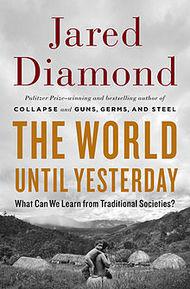
We citizens of all big modern industrialized societies take for granted many features shared among those societies—such as encountering strangers every day without freaking out, living in societies of thousands or millions of people under a central government with laws and police, and eating food grown by other people. We forget that all of those shared features emerged only recently in the history of the human species. Until then, all people lived in tiny societies of just a few dozen or a few hundred people, where encounters with strangers were rare and terrifying, central governments didn’t exist, and everyone grew or hunted and gathered their own food. In the modern world today, there still remain many small traditional societies retaining many of those traditional features of human history. While tribal societies are in some respects very different from our modern industrial societies, in other respects they are similar, because they confront the same universal human problems of bringing up children, growing old, resolving disputes, staying healthy, and dealing with dangers.
Jared Diamond will discuss tribal solutions to these problems, on the basis of his 50 years of experience of living and working among traditional societies. It turns out that many of the ways in which traditional peoples solve those universal human problems are ones that we can incorporate with great profit into our lives. For instance, Diamond will show you why you should stop worrying about dangers from terrorists and plane crashes, and start paying serious attention to the dangers of slipping in the shower, on the stairs, or on the sidewalk.

In recent decades, astronomers have discovered at least 3,264 planets orbiting nearby stars, many of those planets similar in size to our planet Earth, and some of them with conditions suitable for the evolution of life. We now estimate that the whole universe contains on the order of a billion planets supporting life, some of those life forms less intelligent than us, some more intelligent than us. Why, then, have we never been visited by flying saucers? And what would an intelligent creature from the Andromeda Nebula, upon visiting Earth, conclude about human religion?
The visitor would notice that religion is virtually ubiquitous among human societies, but that it costs humans huge amounts of time and resources. Why, then, haven’t atheistic societies, which could devote all of that time and resources to other purposes, thereby gained a big advantage and taken over the Earth? The Andromedan visitor would realize that human religion also serves functions and brings at least seven types of benefits, which have changed in importance over the course of human history. These changes suggest guesses about how human religion will change during the next 50 years.
Today, there are huge differences between peoples of the five inhabited continents in their wealth and power. In particular, over the last five centuries, European peoples have expanded and conquered around the world. Why did history turn out that way, instead of in a different or opposite way? Why didn’t the Aztec Emperor Montezuma conquer Spain, instead of the actual result that soldiers of Spain’s emperor conquered the Aztecs?
13,000 years ago, all peoples on all continents were hunter/gatherers, living at approximately similar levels of technology and social organization and power. Hence the inequalities of the modern world must have arisen from differences in rates of societal development on the different continents over the last 13,000 years. Those different rates of development constitute the biggest question about human history. How can we account for those different rates of development? Jared Diamond will discuss that big question in the light of his famous Pulitzer Prize-winning book Guns, Germs, and Steel.
The U.S. is the richest country in the world, with the world’s strongest military. Those strengths of ours arise from our underlying geographic, socio-economic, and political advantages. But history shows us that countries enjoying advantages can squander them, as has happened to Argentina, Brazil, and China. In this keynote, Jared Diamond explains that the U.S. today faces four fundamental unfolding problems that threaten American democracy, wealth, and power. History also shows us that some nations have confronted and solved unfolding problems, while other nations haven’t. What factors make it either more likely or less likely that we Americans will solve our own emerging problems?